Secrets of the Showroom: How Do Jewelers Get Jewelry So Incredibly Shiny?
We have all experienced it. You walk past a jewelry storefront, and the pieces in the window catch the light so intensely they practically stop you in your tracks. Or maybe you’ve handed over a dull, scratched heirloom ring to a local jeweler and received back a mirror-smooth, blindingly bright piece of art.
At home, you can wash away dirt with some dish soap, but it never quite achieves that spectacular, fluid-like reflection.
What is the secret? Do jewelers possess a magical chemical? As specialists in surface-restoration and cleaning machinery at Creworks, we are here to pull back the curtain. The truth is, jewelers don’t just “wash” jewelry to make it shiny—they use a precise, multi-stage engineering process that physically alters the metal’s surface.
Here is exactly how they do it.
1. The Big Secret: Shiny Means Smooth
To understand how jewelers achieve that high-luster finish, we have to look at the physics of light.
When jewelry looks dull, it’s not just because it’s dirty; it’s because the metal has thousands of microscopic scratches from daily wear. When light hits these micro-scratches, it scatters in every direction (diffuse reflection), making the metal look foggy or matte.
Dull Metal: Light hits micro-scratches ➔ Scatters in all directions ➔ Matte/Foggy appearance
Shiny Metal: Light hits perfectly level surface ➔ Bounces back uniformly ➔ Mirror-like reflection
To make jewelry shiny, a jeweler must level the playing field. They physically shave down and smooth out those micro-scratches so that light bounces off the metal uniformly, like a pristine mirror.
2. The Multi-Step Polishing Progression
The real magic happens at the polishing lathe—a high-speed motor that spins various buffing wheels at up to 3,450 RPM. Jewelers use a sequence of abrasive blocks made of wax, grease, and micro-fine mineral powders to meticulously smooth out the metal.
3. Blasting Away the Polish Residue
When jewelry comes off the polishing wheel, it actually looks terrible. It is covered in a greasy, black, waxy paste left behind by the polishing compounds.
To reveal the hard work, jewelers turn to industrial cleaning machinery to strip away the wax without touching the newly polished metal:
-
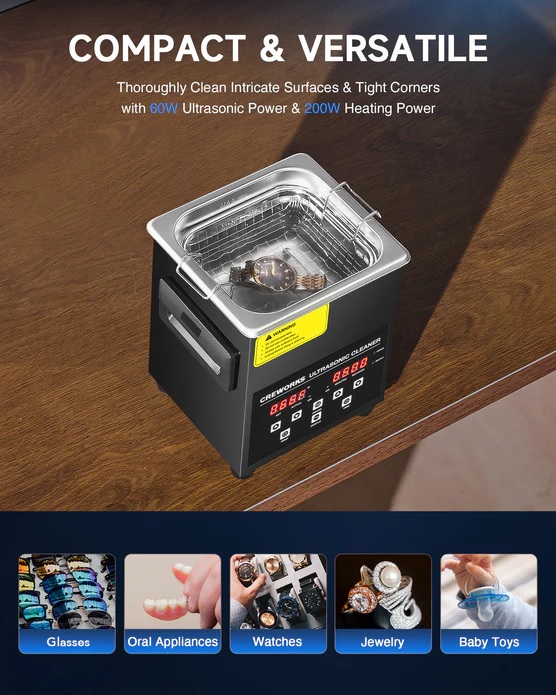
The Ultrasonic Bath: The piece is dropped into an industrial ultrasonic tank—like a Creworks Digital Ultrasonic Cleaner—filled with a heated, ammoniated cleaning solution. The machine sends 40kHz sound waves through the liquid, creating millions of micro-bubbles that implode against the jewelry, instantly blasting away the sticky polishing grease from the tightest prongs and filigree.
-
The Steam Blast: Finally, the jeweler grabs the piece with tweezers and holds it under a high-pressure steam gun. The 100+ PSI jet of superheated steam blows away any lingering chemical residue, leaving the piece totally spotless and dry within seconds.
4. The Final Touch: Rhodium Plating (For White Gold)
Have you ever wondered why white gold jewelry at the store looks so blindingly white, while yours at home might start looking slightly warm or yellowish over the years?
White gold is actually an alloy of natural yellow gold mixed with white metals (like palladium or manganese). It naturally has a slight yellowish tint. To get that ultra-bright, chrome-like shine, jewelers submerge the polished jewelry into an electroplating bath containing liquid Rhodium—a rare metal from the platinum family that costs thousands of dollars per ounce.
Using an electrical current, a microscopic layer of rhodium bonds to the outside of the ring. Rhodium is incredibly hard and highly reflective, giving white gold its signature, ice-bright sparkle.
Can You Replicate This Shine at Home?
While you shouldn’t use a high-speed industrial polishing lathe without training (it can easily catch jewelry and warp it!), you can absolutely replicate the professional cleaning and buffing steps at home:
The Home Showroom Setup
Deep Clean Sonicly: Use a compact Creworks 2L Ultrasonic Cleaner with warm water and a splash of dish soap or jewelry concentrate to remove the dirt hiding under your gems.
Chemical Tarnish Removal: For silver pieces, use a liquid tarnish remover or a baking soda bath to strip oxidation chemically without scratching.
The Micro-Buff: Invest in a high-quality, dual-ply Jewelry Polishing Cloth. The inner layer is embedded with micro-fine professional polishing compounds (similar to rouge) that safely buff away minor daily scuffs by hand, while the outer cloth adds the final mirror shine.
By understanding that real shine comes from cleanliness and smoothness, you can keep your jewelry looking like it just stepped out of a showroom display case!