Helix Size Guide: Gauge, Post Length & Hoop Diameter Explained
Introduction
Not all helix piercings are created equal. Your friend’s perfectly fitted 16G stud might spin loose on your ear by day two. Or worse: you grab what feels right and it digs into your helix all day long. The secret? Helix size guide rules are based on one thing that actually matters: your specific ear anatomy.
This guide breaks down the three measurements that define helix fit (gauge, post length, and hoop diameter) so you know exactly what to look for before you shop for your next gold helix earring. No guesswork, no returns.
What a Helix Piercing Actually Is: And Why Size Changes by Placement
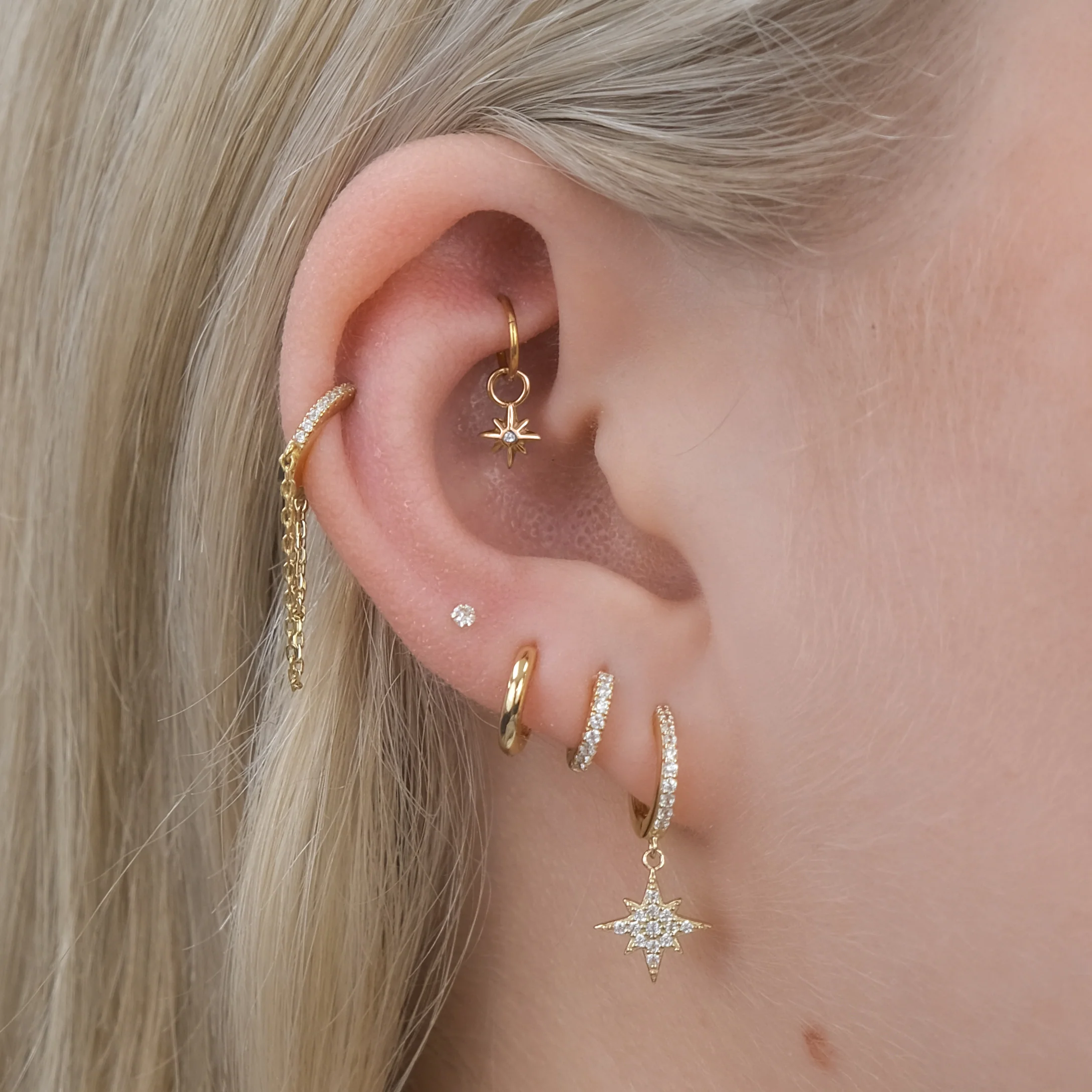
A “helix piercing” isn’t just one piercing: it’s a region. The helix is the curved outer edge of your ear, and it runs top to bottom. Piercers talk about high helix, mid helix, and low helix to be specific about placement, and each one calls for a different size.
High, Mid, and Low Helix
- High helix: At the top of your ear’s curve (the tightest placement). Requires shorter post lengths (5mm).
- Mid helix: The middle of the curve. The most versatile placement. Works with 6.5mm across nearly all ear shapes.
- Low helix: At the bottom, closer to the lobe. Thicker cartilage here means longer posts needed (8mm for fresh, 6.5mm for healed).
Why Placement Changes How the Jewelry Sits
The shape of your ear matters. At the top, the helix curves sharply: a longer post sticks out. At the bottom, the curve is gentler and your ear is thicker, so you need more length to reach the piercing hole and sit flush. It’s anatomy, not guessing.
Why Ear Thickness Matters
Everyone’s cartilage is different. Some people have thin, delicate ear cartilage; others have thicker structure. A 6.5mm post might sit perfectly flush on one person’s helix and poke out noticeably on another’s. This is why the at-home measurement method (covered below) beats guessing: your ear tells you the real size.
Gauge, Post Length, and Hoop Diameter Explained
You see these terms everywhere when shopping for helix earrings. Here’s what they mean, and why millimeters matter more than vague adjectives like “small” or “large.”
What Gauge Means
Gauge = the thickness of the post wire. It’s measured in numbers, and, confusingly, higher numbers mean thinner wires. Think of it like thread thickness.
- 18G (standard for helix):0mm thick
- 16G (thicker):2mm thick
- 20G/22G (older/thinner):8mm and 0.6mm
The gauge of your piercing hole was set when you got pierced. You can’t wear 16G jewelry in an 18G piercing: it’ll fall out. So the first step is always: know your gauge.
18G is the modern standard, what professional piercers use and what most brands stock. 16G is thicker and less common for helix (more typical for daith or conch). 20G and 22G are legacy sizes; if your helix is decades old, you can stretch up to 18G or find legacy-sized 14k solid gold jewelry to match.
What Post Length Means
Post length = the measurement from the back of the flat disc to the tip of the front setting. It’s the part that sits inside your piercing.
Post length determines how flush your earring sits:
- Too short? The setting pokes out and creates an unrefined look.
- Too long? Pressure builds inside your piercing and causes irritation.
- Just right? You forget you’re wearing it.
Standard post lengths are 5mm, 6.5mm, 8mm, and 10mm. No in-between sizes: precision matters.
What Hoop Diameter Means
Diameter = the width of a hoop, measured edge-to-edge through the center. It determines how close the hoop sits to your ear.
- Smaller diameter (4–6mm): Sits snug, hugs the helix closely.
- Larger diameter (8–10mm+): Hangs looser, creates more movement.
A hoop that’s too tight will dig in and irritate over time. Too loose and it catches on hair and fabric. Finding your diameter is as important as post length.
Why Millimeters Matter More Than “Small” or “Large”
Here’s the thing: “small” to one person is “medium” to another. Millimeters are objective. A 6mm hoop is always 6mm, whether you’re in New York or Tokyo. Using specific measurements ensures you get exactly what your ear needs: not a guess wrapped in marketing language.
How Do I Measure My Helix Piercing at Home?
There are three ways to find your size: measure at home, ask a professional piercer.
How to Identify Your Current Gauge
Ask a professional piercer to check your gauge using a gauge wheel. Cost: $0. Time: 2 minutes. This is the fastest, most accurate method.
Alternatively, if you have digital calipers (super cheap on Amazon), you can measure the post thickness of an earring you own and compare it to the gauge standard above. It’s not fool-proof, but it works.
Measuring Post Length Correctly
The marker method is surprisingly accurate and my recommended approach.
- Insert an earring you already own that fits okay (even if it’s not perfect).
- Have a friend mark the post with a marker or pen at the exact point where it exits the back of your piercing. Let the ink dry for 2 minutes (this prevents smudging).
- Measure from the base of the front setting to the mark. That’s your wearable length.
- Size up one increment (e.g., if you measure 6mm, try 6.5mm or 8mm) for fresh piercings to give swelling room.
This method is reliable because it’s measured on your ear, accounting for your specific anatomy.
Measuring Hoop Diameter Correctly
For hoops, it’s simpler: measure across the hoop from the inside edge to the inside edge. Use calipers or even a ruler if you’re careful. This tells you the actual space inside the hoop: how close it’ll sit to your ear.
What to Do If the Current Jewelry Size Is Unknown
Don’t panic. 6.5mm is the magic number: it works for most helix placements and ear shapes. If you’ve never measured before and have no reference point, start there. If it feels slightly loose, go down to 5mm. If it feels tight, go up to 8mm.
How to Tell Whether You Need 5mm, 6.5mm, 8mm, or 10mm
- 5mm: High helix, tight placements, or very petite ears.
- 5mm: Mid-helix, most placements, “the Goldilocks choice.”
- 8mm: Low helix, deeper piercings, room for swelling (fresh piercings).
- 10mm: Deep-set anatomy, larger ears, or specific daith/conch placements.
When in doubt, professional piercers are your fastest answer. A quick in-person check costs nothing and takes 60 seconds.
Helix Size Chart by Gauge, Length, and Diameter
Use this as your reference guide while shopping.
Standard Helix Gauge Chart
| Gauge | Thickness | Best For | Rarity |
| 18G | 1.0mm | Fresh helix piercings, standard wear | Most common |
| 16G | 1.2mm | Less common for helix (more daith/conch) | Older piercings |
| 20G/22G | 0.8mm / 0.6mm | Very old piercings from 1990s–2000s | Legacy only |
Standard Post Length Chart
| Length | Best For |
| 5mm | High helix, tight placements, petite ears |
| 6.5mm | Mid-helix, versatile placement, works almost everywhere |
| 8mm | Low helix, fresh piercings (room for swelling), deeper anatomy |
| 10mm | Very deep piercings, larger ears, daith/conch |
Standard Hoop Diameter Chart
| Diameter | Style | Comfort |
| 4–5mm | Snug, close to ear | Best for sensitive or tight placements |
| 6–7mm | Mid-range, balanced | Most versatile |
| 8–10mm+ | Loose, dramatic | Best for statement styling |
Why Sizing Charts Are Starting Points, Not Rigid Rules
Everyone’s ear is unique, and no gold helix earring fits every person the same way. These are guidelines based on typical anatomy; but “typical” isn’t universal. If a chart says 6.5mm and your ear needs 7mm, trust your ear. The marker method and professional piercer feedback beat any chart.
FAQ
Q: What gauge is a helix piercing usually?
A: 18G is the modern professional standard. If your helix was pierced in the last 15 years, it’s almost certainly 18G. Older piercings (pre-2010) might be 16G or even 20G. Ask your piercer if you’re unsure: they can tell in seconds.
Q: What is the best post length for a helix?
A: 6.5mm for healed piercings, 8mm for fresh piercings (to accommodate swelling). High helix placements need 5mm; low helix placements might need 8–10mm. Measure to know for sure.